
Watch our short video about Outside Legal Counsel PLC
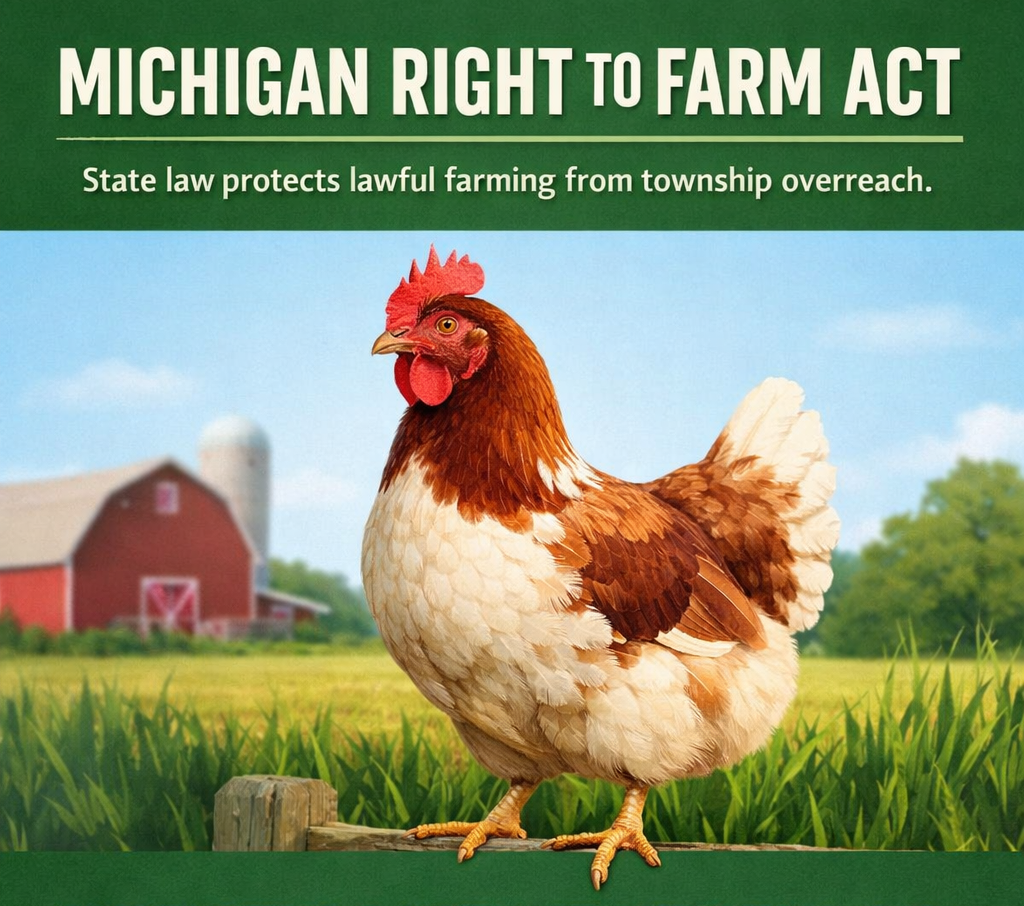 The Michigan Right to Farm Act exists to protect farmers and agricultural landowners from local zoning, nuisance, and enforcement actions that attempt to regulate farming out of existence. When the Act applies, local governments do not get to substitute their judgment for state law.
The Michigan Right to Farm Act (Public Act 93 of 1981) is a state law enacted to define farm uses, operations, practices, and products and to limit circumstances under which a farm or farm operation can be found a nuisance under Michigan law. This statutory protection has been amended and interpreted to preempt local ordinances that conflict with the Act or with GAAMPs developed under it.
Yet across Michigan, townships continue to ignore and defy that clear legal boundary. Michigan law (MCL 286.473(1)) provides:
A farm or farm operation shall not be found to be a public or private nuisance if the farm or farm operation alleged to be a nuisance conforms to generally accepted agricultural and management practices ["GAAMPs"] according to policy determined by the Michigan commission of agriculture.
Outside Legal Counsel has now defeated multiple township enforcement actions brought in defiance of the Right to Farm Act, confirming in real cases that RTFA protections are not theoretical. They are enforceable.
The Right to Farm Act is a statewide preemption statute. It was enacted because agriculture cannot function if every township is free to regulate farming based on local politics, neighbor complaints, or shifting enforcement priorities. Michigan’s Right to Farm Act provides a nuisance defense for GAAMP-compliant farms. MCL 286.474(6) mandates:
Beginning June 1, 2000, except as otherwise provided in this section, it is the express legislative intent that this act preempt any local ordinance, regulation, or resolution that purports to extend or revise in any manner the provisions of this act or generally accepted agricultural and management practices developed under this act. Except as otherwise provided in this section, a local unit of government shall not enact, maintain, or enforce an ordinance, regulation, or resolution that conflicts in any manner with this act or generally accepted agricultural and management practices developed under this act.
GAAMPs (Generally Accepted Agricultural and Management Practices) are state-level adopted guideposts for farm operations, covering topics like manure management, livestock care, and farm market operations. When a farm complies with applicable GAAMPs, it strengthens its statutory protection under the Act. The Michigan Department of Agriculture and Rural Development annually updates GAAMPs claiming them to be 'science-based practices' for farm management activies that inform whether an operation qualifies for RTFA protection. Agricultural operations that fall within the scope of the Act and comply with GAAMPs are fully protected from the effects of local zoning ordinances and nuisance enforcement lawsuits. The Act was designed to provide uniformity, stability, and predictability for farmers operating lawfully.
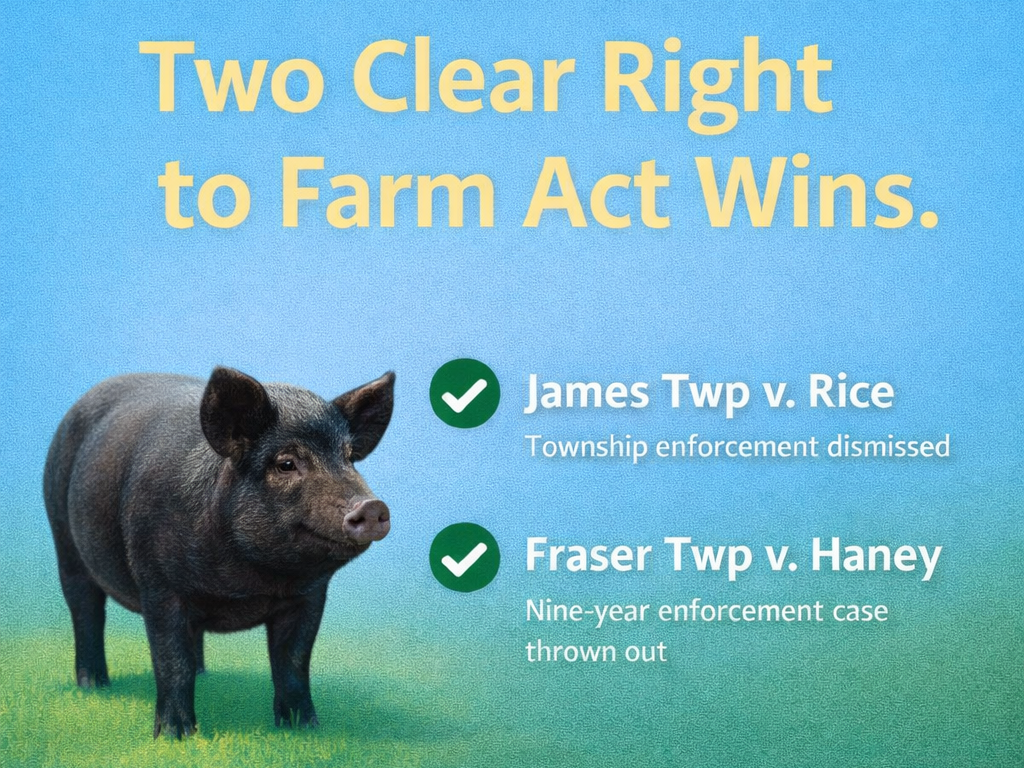 In James Township v. Rice, the township attempted to apply local restrictions to agricultural activity protected by the Right to Farm Act. The court rejected that effort and confirmed a foundational rule of Michigan law: when the Right to Farm Act applies, township zoning ordinances must yield. It also requires losing governments to pay the sued farm or farmer's attorney fees and costs.
In Fraser Township v. Haney, a township pursued enforcement against a working piggery for nearly nine years despite the protections guaranteed by state law. That case, too, was later dismissed in full with attorney fees awarded. The ruling secured by OLC reinforced that municipalities cannot use prolonged enforcement, nuisance theories, or zoning pressure as an end-run around RTFA preemption.
Together, these cases demonstrate that courts will enforce the Right to Farm Act when it is properly asserted, even when townships resist doing so.
Rice and Haney confirm that townships do not have a veto over lawful agricultural activity. They cannot override the Right to Farm Act through zoning citations, selective enforcement, or improper litigation. Compliance with the Act and applicable GAAMPs matters, and (when presented by experienced counsel) courts will protect farmers who operate within that framework.
Many Michigan farm owners ask: “Does the RTFA apply to my operation?” The Act generally applies to commercial farm operations that produce farm products and that conform with relevant GAAMPs. When these conditions are met, the Act can provide both nuisance protection and preemption of conflicting local ordinances. A property rights lawyer experienced in RTFA litigation can evaluate your situation and help determine whether the Act’s protections apply.
Farmers often seek legal help too long after a township begins issuing zoning citations, claiming the Right to Farm Act does not apply, threatening nuisance enforcement tied to normal farming activity, or using inspections and delays to pressure operational changes. By the time enforcement begins, the legal framing already matters. Early mistakes can weaken an otherwise strong RTFA defense.
The Right to Farm Act only works when it is asserted correctly and early.
OLC focuses on property-rights litigation and statutory preemption cases, including Right to Farm Act defense. We do not treat RTFA disputes as routine zoning disagreements. We litigate them as state-law preemption cases grounded in property rights.
Our firm has now successfully forced dismissal of multiple township enforcement actions brought in violation of the Right to Farm Act. We understand how municipalities structure these cases and how to dismantle them before unlawful enforcement becomes permanent. Our RTFA defense work has been successful in protecting everything from raising backyard chickens to piggeries. Clients of Outside Legal Counsel have enjoyed litigation success in securing legal protections from overzealous governments and their attacks on local farming operations.
Our law firm represents farmers and agricultural landowners throughout Michigan in Right to Farm Act disputes, zoning conflicts, nuisance claims, and property-rights litigation. If your farm operation is under threat, or if enforcement appears imminent, delay can be costly. Townships often rely on hesitation and uncertainty. State law does not.
The Right to Farm Act protects farmers only when it is enforced. If you have been sued or threatened to be sued by a local municipality or by a neighbor regarding your farm operations, or a township is actively challenging your agricultural operation in court, contact Outside Legal Counsel to discuss your rights under Michigan law and whether RTFA preemption applies to your situation.

Watch our short video about Outside Legal Counsel PLC
Outside Legal Counsel PLC is available to assist new and current clients with matters on a confidential basis and will consider representation on a case-by-case basis.